
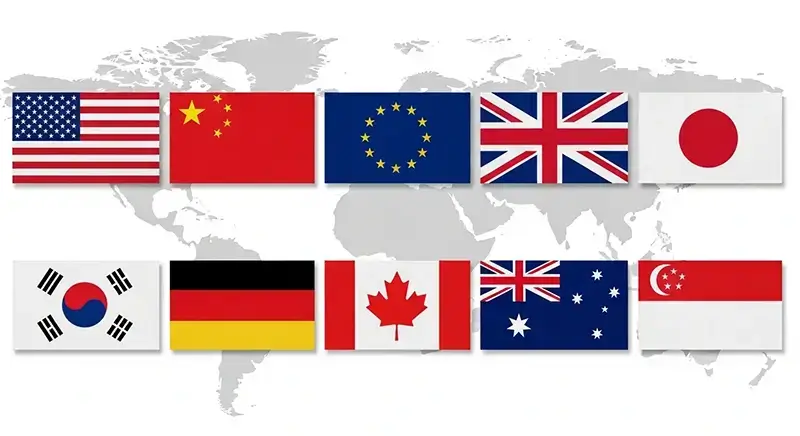
The trademark world is more dynamic than ever. As global commerce expands, businesses are realizing that owning a registered trademark isn't just a formality—it's a competitive edge. Some countries have developed particularly active trademark markets, where brands are created, traded, and licensed at a remarkable pace. These markets attract global entrepreneurs who want to buy registered trademarks, sell existing ones, or invest in intellectual property as part of their brand strategy.
Below are the Top 10 countries with the most active trademark markets, reflecting both registration volume and commercial activity in trademark transactions.
1. United States
The U.S. leads the world in trademark filings and marketplace activity. With a strong economy and a deep culture of entrepreneurship, U.S. trademarks for sale are among the most sought-after worldwide. The USPTO (United States Patent and Trademark Office) provides a transparent and reliable registration process, making it easier for foreign buyers to acquire or license American trademarks. Platforms offering verified U.S. trademarks for sale have become key resources for global investors and e-commerce businesses.
2. China
China's trademark market has exploded over the last decade. It now records the highest number of annual applications globally, driven by manufacturing, technology, and export-oriented businesses. Many Chinese companies actively register international trademarks to expand overseas, while others sell or license marks to foreign partners. The Chinese IP office (CNIPA) has improved enforcement and digitalization, helping make China one of the most active hubs for trademark trading.
3. European Union
The EUIPO (European Union Intellectual Property Office) oversees trademarks that cover all 27 EU member states, giving holders broad protection under a single filing. This makes EU trademarks valuable assets for global brands. Businesses often buy EU-registered trademarks to instantly access major European markets. Countries like Germany, France, and the Netherlands also maintain strong national IP systems that complement the EU trademark network.
4. United Kingdom
Post-Brexit, the U.K. reestablished its own independent trademark system under the UKIPO. Its clear rules, efficient procedures, and reputation for fairness make it one of the most respected IP markets. The U.K. also has a vibrant trademark resale scene, particularly for fashion, technology, and entertainment-related brands. Many global investors look for verified U.K. trademarks for sale to secure brand presence in one of the world's top consumer markets.
5. Japan
Japan's trademark environment combines innovation with precision. Managed by the Japan Patent Office (JPO), the country maintains a balanced approach between strong protection and user-friendly processes. Japanese trademarks are particularly active in technology, cosmetics, and consumer electronics sectors. With the growing global appreciation for Japanese design and quality, demand for Japanese-registered trademarks has increased significantly in recent years.
6. South Korea
South Korea's rise as a branding powerhouse—driven by K-pop, fashion, and digital innovation—has fueled trademark growth. The Korean Intellectual Property Office (KIPO) manages a robust and modernized registration system. Korean trademarks attract buyers from industries seeking to associate with Korea's creative energy, especially in beauty, media, and lifestyle sectors. The country is also developing more structured trademark marketplaces for international transactions.
7. Germany
As Europe's largest economy, Germany remains a core market for trademark registration and licensing. Known for engineering, manufacturing, and reliability, German trademarks often carry a high reputation value. The DPMA (German Patent and Trade Mark Office) handles applications efficiently, and the country's strong legal system supports international enforcement. For many investors, acquiring a German-registered trademark represents a mark of quality and trust.
8. Canada
Canada's trademark market has grown rapidly thanks to its stable economy and simplified procedures under the Canadian Intellectual Property Office (CIPO). Recent updates to the law allow for international applications through the Madrid Protocol, making Canada more accessible to global trademark traders. Canadian trademarks are often linked to sustainable, ethical, and technology-driven brands—qualities that appeal to global buyers looking for verified assets.
9. Australia
Australia stands out for its transparent IP framework and strong enforcement record. The IP Australia office has streamlined processes and actively supports startups and exporters. Australian trademarks are valuable for businesses targeting the Asia-Pacific region, and the country's market is known for its openness to international trademark trading and partnerships.
10. Singapore
Singapore has built itself into a hub for intellectual property and trade in Southeast Asia. The Intellectual Property Office of Singapore (IPOS) operates one of the most efficient systems globally. Many multinational corporations base their regional IP management there, while local businesses actively register and trade trademarks. Singapore's global connectivity, clear legal standards, and tax-friendly policies make it a rising destination for trademark investors.
Why These Markets Matter
These ten countries not only lead in registration numbers but also in trademark liquidity—the ability to buy, sell, or license brands securely. For entrepreneurs, investors, and companies expanding internationally, these markets offer the best environments for verified and enforceable ownership transfers. Whether you're looking to buy a registered trademark, explore U.S. trademarks for sale, or invest in premium domains for sale that complement your brand, understanding these active trademark ecosystems helps you make smarter business decisions.
In today's global economy, trademarks are no longer just legal identifiers—they are tradeable assets. The world's most active trademark markets are shaping a new era of brand ownership, where intellectual property moves fluidly across borders, industries, and opportunities.